


Community
Learning & mobility
This journey continues my long-term research Toward Midwifery and builds on earlier projects such as From Body to Body, drawing on the notion of peratis (περατής)—one who helps another to cross—as a relational space of transition. Here, midwifery becomes methodology, performative structure, and invitation. Throughout the process, the role of the “Peratis” shifts continuously between place, myself, the people I meet, and the more-than-human beings encountered along the way.
My research engages with silenced histories of midwifery between Greece and Turkey, rooted in my family’s migration during the forced population exchange following the Treaty of Lausanne. As a third-generation descendant of displaced communities, I approach history as embodied and place-based, wishing to continue tracing the routes and memories of populations once inhabiting the regions of Cappadocia.
Through interviews, memory mapping, and shared walks, I hope to open spaces for dialogue, exchange, memory, and care. Approaching history as a living archive and a relational network of human and more-than-human beings, I seek to cultivate collective practices grounded in listening, coexistence, and attentiveness. Through walking, gathering, and being with the river, these practices become ways of fostering belonging—of crossing together through memory, landscape, and time.
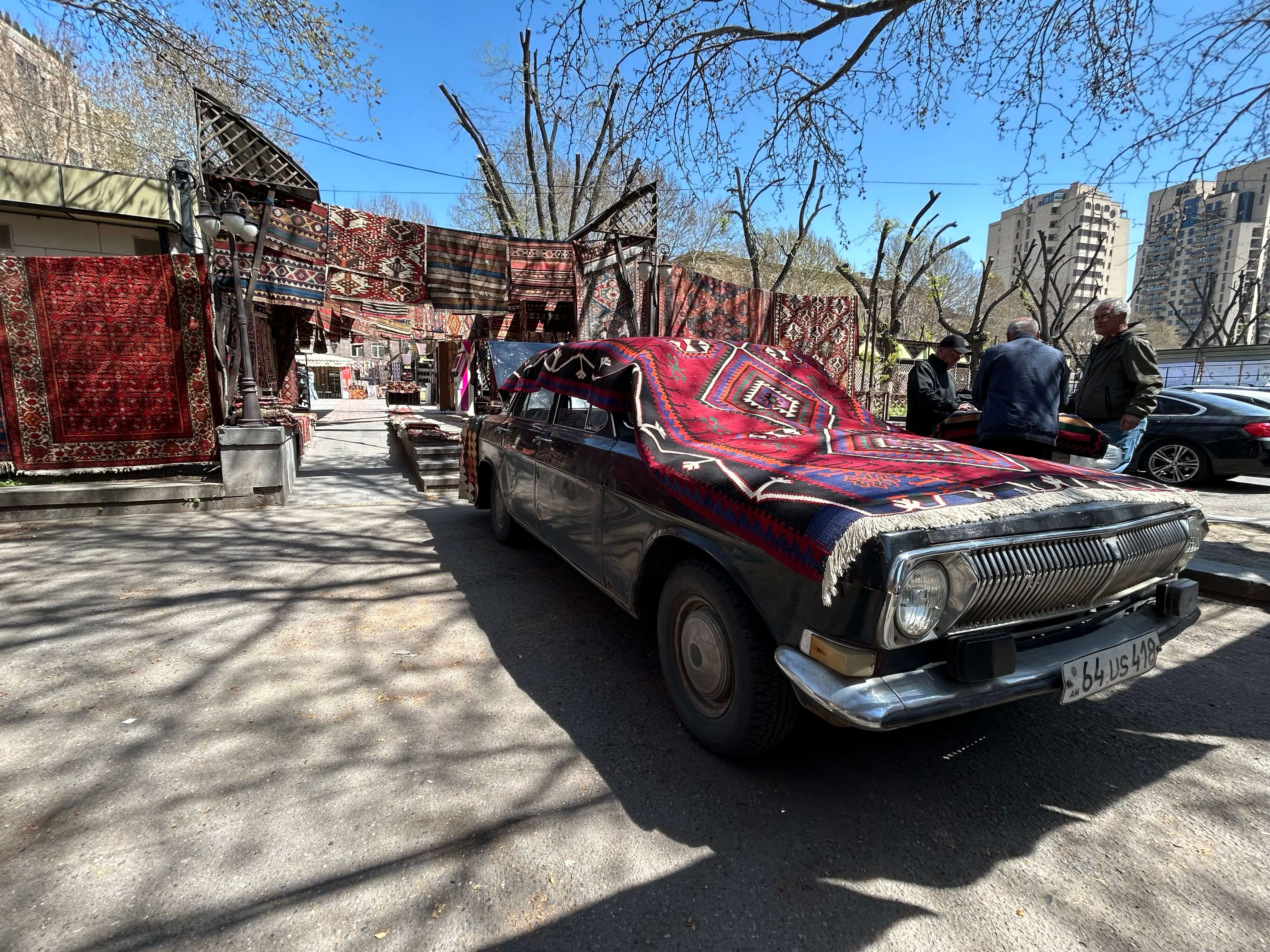
I learned to write in between the lines. The liaison of letters creates syllables.
I learned to walk on her feet.
I learn to read letter by letter.
And sound by sound words were shared but first I learned to speak my feelings with my eyes.
I find myself changing notebooks, it is a complex choice and difficult moment.
So simple but not enough as no lines exist
And I always felt the agony of missing the line.
I find myself training to walk.
I returned with a decision from the Netherlands to learn to walk.
I literally thought I would be learning how to walk again, like an athlete, this time with structure, training would be my way through the intimate relationship of my father who used to be a professional athlete.
But as with all materials, I suffocate in techniques, him being wise and never demanded structure of me. We went for walks by the sea.
Learning to walk,
Walk outside the house
Walk to the market
Walk to meet friends
Walk to see the morning sun
Walk to walk to walk
Walking, walking and sharing, walking and learning. Walking in history became an invitation of learning to know myself. I went to my ancestral land to walk where they walked, I looked for traces of what was to understand what is now, how to live in a country which is competent in the trauma of transition. Of forced exchange of populations, of forced migration, where being a natural border of continents made migration an inevitable particle of what we call Greece.
I arrived in Yerevan following the desire to walk in history. I thought we could follow in the footsteps of my grandparents, great aunts, recipes and language in Cappadocia. My search could resemble a spiral of interrupted lines growing in a field. First by interviewing the inner circle of the family, through archives, popular TV shows, literature and History, finally I walked in the fields they walked and met with the river they played with. In stories of trees and humans. And still I feel lost.
When I travel in the West of Europe they ask me repeatedly if I am Turkish or Armenian, I was never asked if I was Greek, Italian or Spanish. Three were the main population inhabiting the areas where my grandparents were growing up: Greek, Turkish and Armenian.
I spoke the text to sleep, remembering before speaking helps me avoid nightmares.
But this text is not still there neither am I.
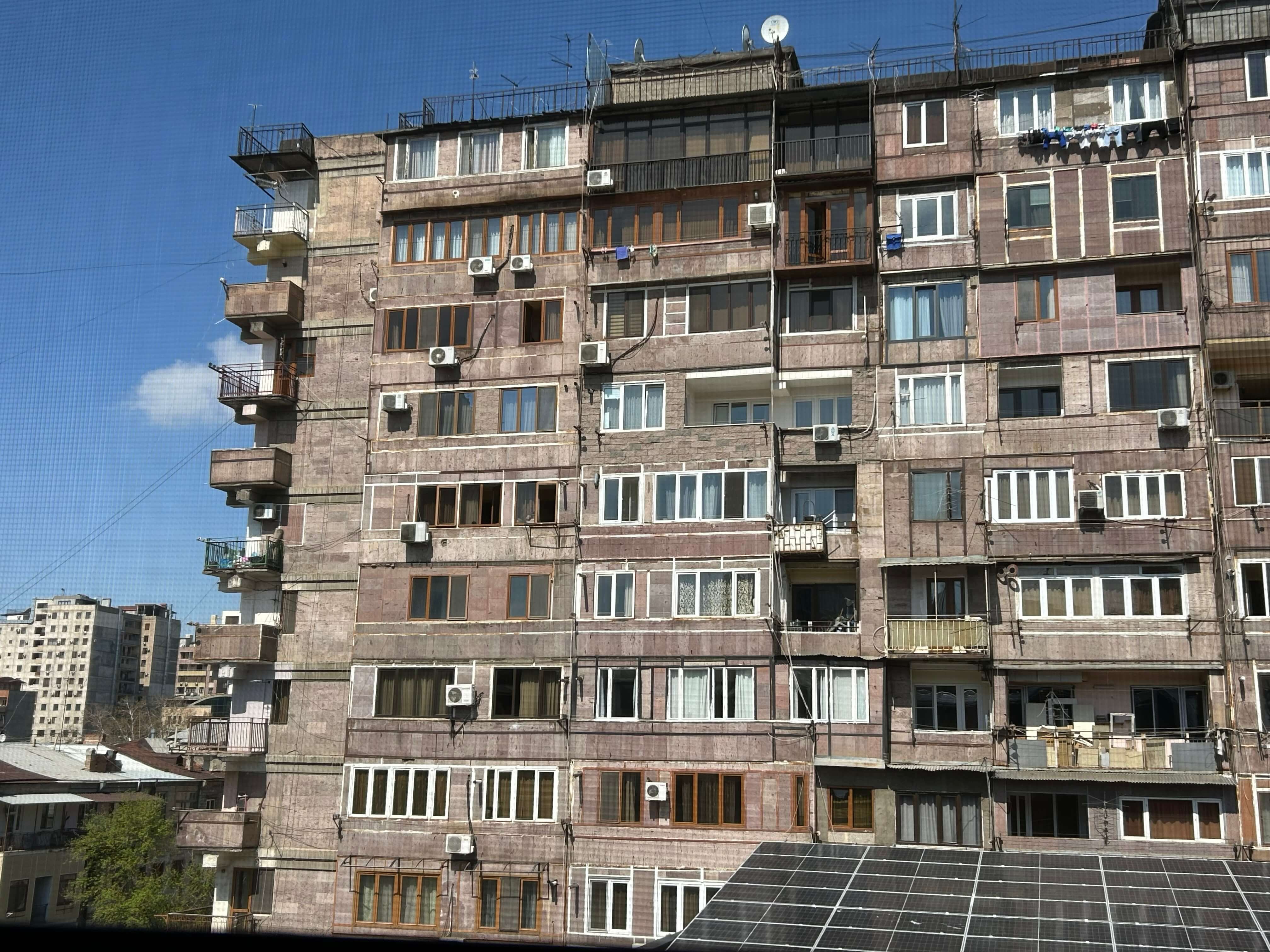
How to walk through layers of history? Through layers of occupation and trauma, each road, building symbol had at least three stories that my host generously shared with me with a smile.
‘Our people look alike but people here smile less’, the statue of Lenin became Mother Armenia.
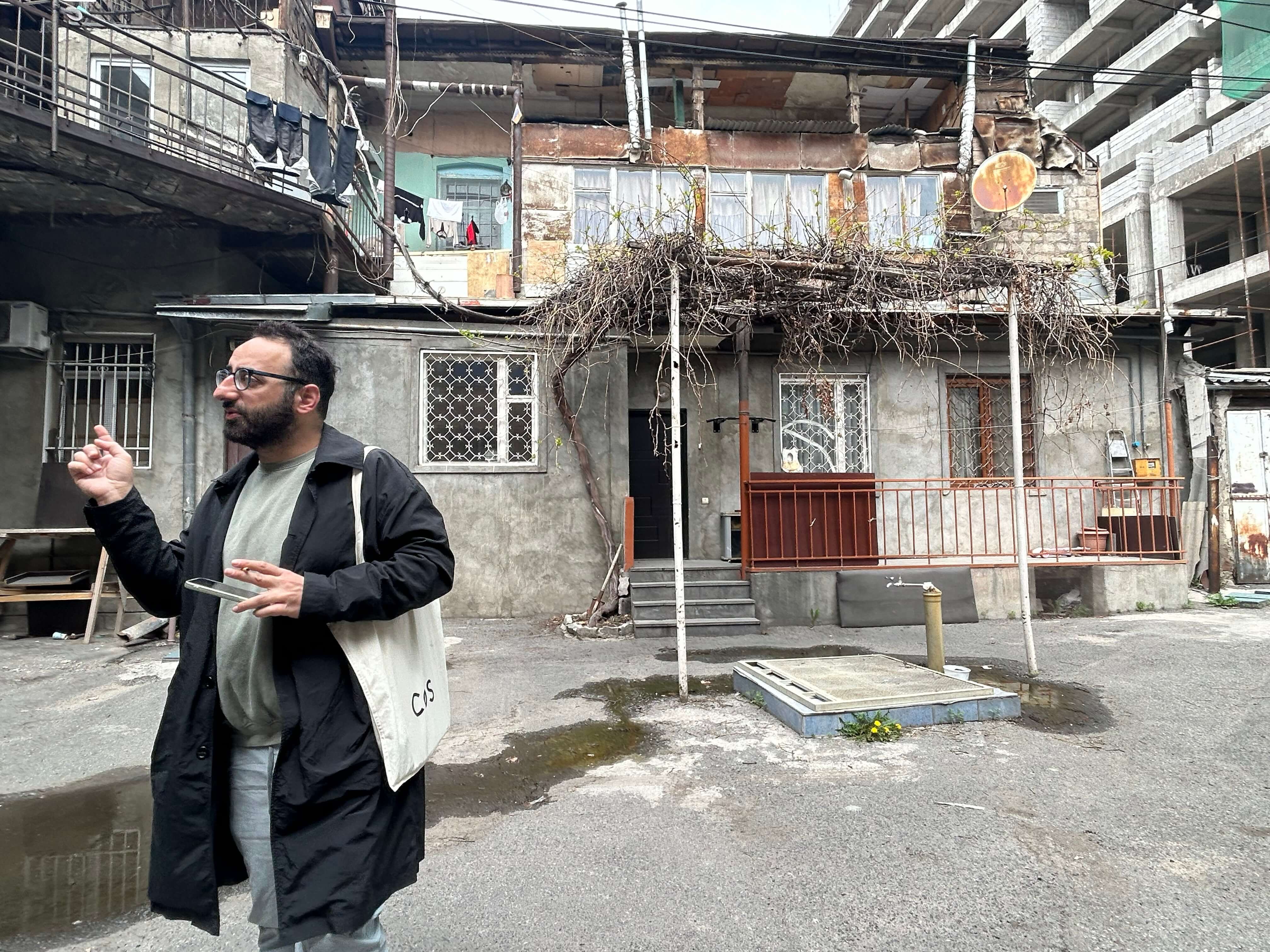
A sociologist writes for the halls in the walls in the bazaar, as carries off memory of what is now replaced by mass building due to gentrification. But we remember, I looked with surprise and not long after I realized even though they were not bullet marks that would be usually glorified and never flown in as memory of a revolution but this is also a revolution.
Collecting traces of untold stories and listening.
I feel like the country has been in a coma, caused by successive occupations of the Otommans, Turkey, and the Soviet Union.
I am staying in a hotel in the center of Yerevan occupied by the vogue aesthetics and the magnificent traces of soviet architecture.
My friend's humor is distinct, navigating through history, irony, facts, memories, personal experiences, research finding, transforms our walks with a question. "We grow up with limited electricity.’ ‘In this cold!’ I say.
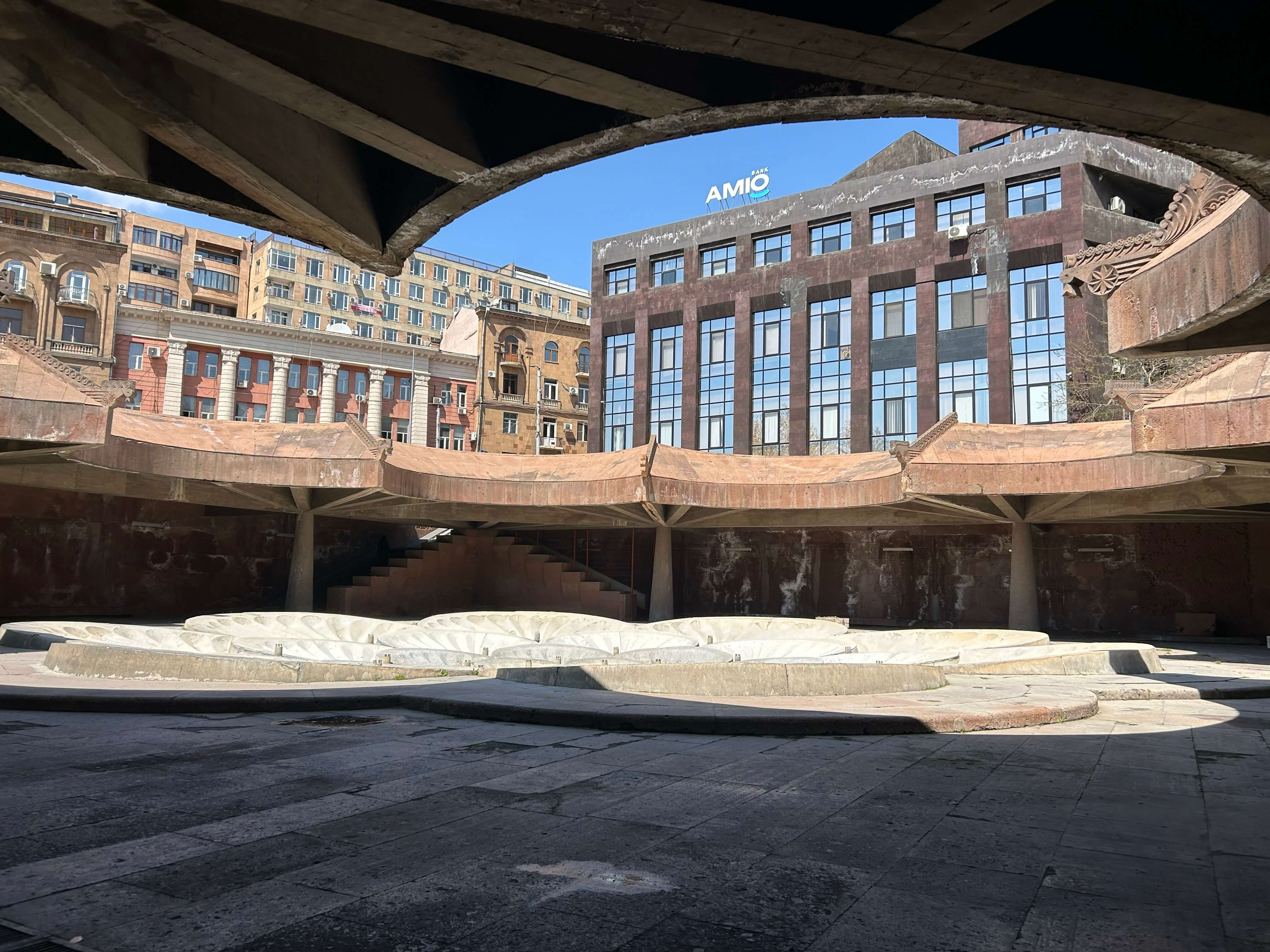
The center is not in the square of Democracy, a museum today, square, fountain, passage as the Soviet wanted, he ironically adds. The bazaar replaced what was usually the center of the Anatolian cities.
The facts are too many, the stories become like the letters their amalgamation creates a feeling and sense, and awareness I can dive as deeply as I wished what I am looking for is not here or at least is covered by so many layers that I can't recognize it.
I couldn't trace what I was looking for.
The alphabet looked carved to me.
Walking walk walk walk walk.
The last day I chose to travel to a country site. I ended up on a Russian tour even though I was promised an English one. Tourism. I met a young couple who helped not to be left behind from the group. He has the right to work in Armenia and speaking the language helps because ‘he had to go’, the girl says. “Otherwise he would have to fight.”
Feminist storytellers, women circles I would rather call them, we meet and we try to share our thoughts, worries, and practices. We share our concerns which become our roots. We follow our intuition, our ancestors, our personal stories, our communities' needs like the old midwives we helped cross over. Feeling at home in the other hidden feminist library we had to change places four times over the last six years. We are making a shelter, a place a bit outside of the city where women can rest. Especially cultural workers, activists, writers, researchers. The recognition of the tiredness that this work can bring tauches me and I am realizing that this is the first time I have heard it claimed so openly. Named as an exhaustion realising the need of care in the works of care. Inspired by the writer Zabel Yesayan they named the house as such.
I feel the water but I don't see it. I am not sure why and naively enough. I ask why the fountains are empty? I refuse to look at maps, I want to be led by the stories.
Unseen rivers have guided my paths. I recently realized I grew up next to one, a stream coming from Penteli mountain to Nea Ionia ending up in the Saronic sea. Podonftis. Thrones who washes your feet. The stream was covered after the arrival of the population which was forcibly exchanged due to the treaty of Lausanne in 1923 which ended the Greco -Turkish war with the charismatic influence of the great powers of the West. Textiles industries, housing, a neighborhood of no running water in the outskirts of Athens hosted the new arriving population. I grew up close to the bazaar formed along the main street where small stores and stories up until today created the flow of history, from the personal to the official narrative, that I still try to discover.
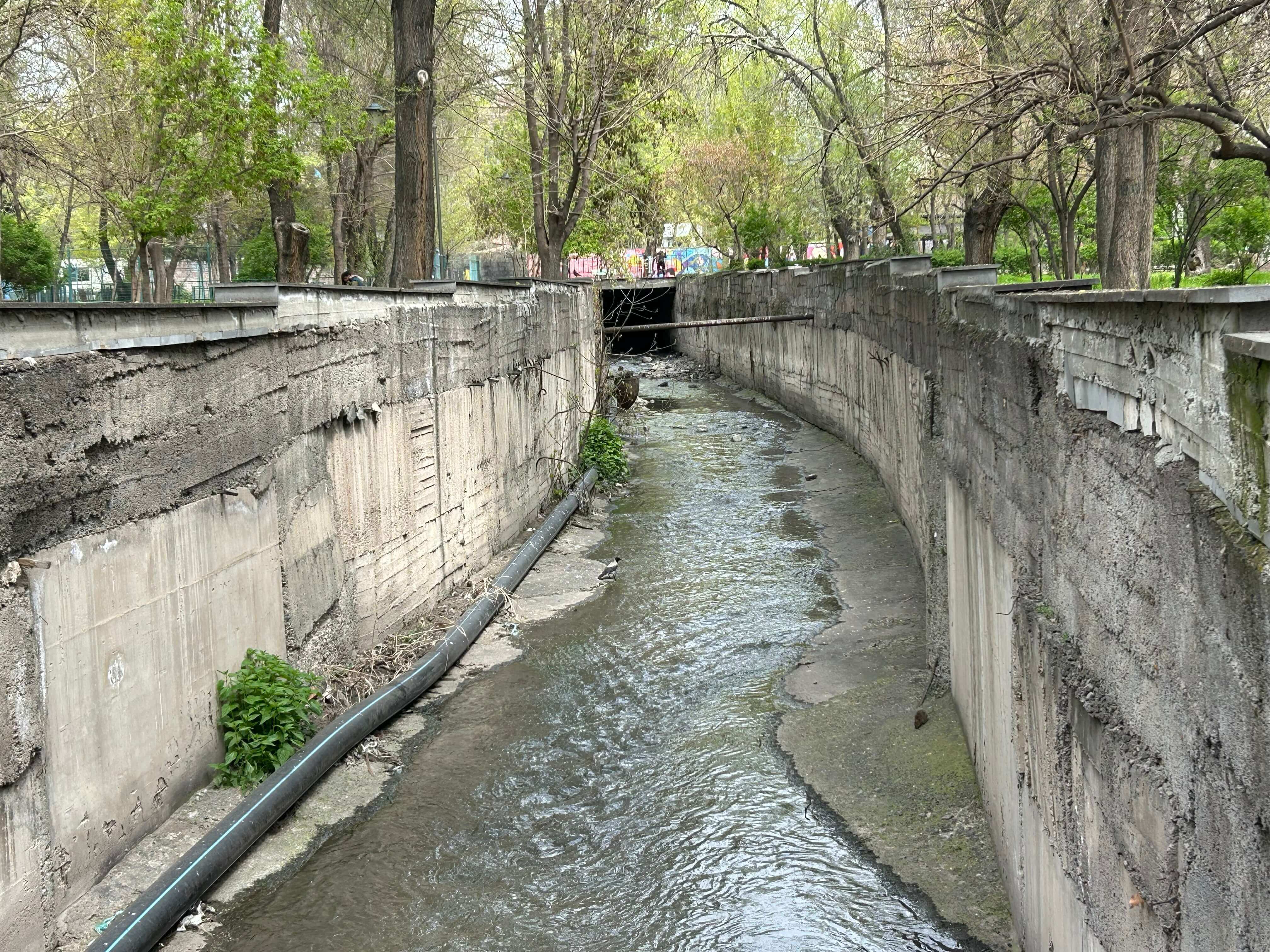
In Yerevan - is Getar - Tigran speaks of it and it seems to be a powerful person but is a river. He guides me in a park of what is left and explains how strange it was when they were collecting microstories of a community and the river seems to be everywhere scattered in the city, which causes a confusion but in the end it is a river as we imagine it has one flow but in reality it can be as dispersed in streams. As the stories in History. What if we included in the dialogue the river and its fragmentation? What would they say?
I meet in daydreaming in the frozen stream my grandmother playing in her village in Ayvali. It could be described as a loss, as a feeling of sorrow that she has died many years ago, a vision, an illusion, a dream and maybe all the above. I always go to the sea maybe because the sea is the vessel of the stories like in women's bodies a birth is enabled, the sea gives birth to the voices of the stories. I didn't find what I looked for, I didn't follow the paths I used to take, I let myself follow the stories, the artifacts, the named and erased monuments, the idea that I failed and see what can be born out of it. It seems that neither this text has been written yet. But some notes to remember the feelings, the learnings, the walks, the unlearnings.
I hear myself talking about my practice becoming even more of an amaglama here, talking about my research on midwifery and history, about Mouries the collective I am part of, the practices developed collectively over the last year through Kilim Athens, Yellow Brick as a practice of hosting as a garden.
Claiming a practice of no ownership, but thinking: do I avoid finding my voice or I learn to hear in a polyphonic composition. Am I learning to play with the line?
Words, names, objects,
I could navigate history only by the names of the streets, each one of them had changed at least three by the time I was told its story.
Ceramic plates
Pomegranates
Oral mapping
Safety
Empty fountains
Soviet Union
Alphabet
Silence
Mountain
Ararat
Women
Bazzaar
Cafe Paul
Border
Group collective
Healing
Disappointment
Apricots
Flavour
Research
Sleep
Unknown trees
Dilalogue
Books
Mother Armenia
River
Archive non archives
Layered oppression
Not find what I wished for
Flower season
Finn alleviation of practices than narratives
Safe library
Maybe the sun was too much
Ιστορημα (Istorima): It mainly means a narrative, a short story (often with a folk or traditional tone), or the record/chronicle of an event.
Anatolian
Transit country
Dialogue
Lenin
The hospital that became the mental hospital, the presidential house, the library and the cafe.
Pink city
River
Women's circle
I claim a blue city
Streets
I am grateful to my host, CSN Lab, for the introduction to Yerevan and Armenian history, as well as to all those who created space for meaningful conversations: Fem Library, Women’s Fund Armenia, and also the unnamed encounters throughout the city with both human and non-human entities.
Supported by VAHA is an initiative of Anadolu Kültür and zusa.
The text is edited by IIsabel Gutierrez Sánchez
Writing on lines
An exchange of practices between Yellow Brick and CSN Lab
10.06.2026
Vasiliki Sifostratoudaki from Yellow Brick visited Yerevan, Armenia in April 2026 as part of the VAHA Learning and Mobility Grant. She reflects on her journey and invites us to walk with her between the lines. Let's hear from her directly:
My recent trip to Yerevan became an extension of an ongoing field research rooted in walking, memory, and oral histories. Moving through the city and encountering its layered histories of displacement, survival, and coexistence, I found myself reflecting on inherited migrations, embodied memory, and the ways histories continue to live through places, bodies, rivers, and everyday encounters. Inspired by Doreen Massey’s understanding of space as a constellation of ongoing stories, I approach place as something continuously shaped through movement, relation, memory, and encounter.This journey continues my long-term research Toward Midwifery and builds on earlier projects such as From Body to Body, drawing on the notion of peratis (περατής)—one who helps another to cross—as a relational space of transition. Here, midwifery becomes methodology, performative structure, and invitation. Throughout the process, the role of the “Peratis” shifts continuously between place, myself, the people I meet, and the more-than-human beings encountered along the way.
My research engages with silenced histories of midwifery between Greece and Turkey, rooted in my family’s migration during the forced population exchange following the Treaty of Lausanne. As a third-generation descendant of displaced communities, I approach history as embodied and place-based, wishing to continue tracing the routes and memories of populations once inhabiting the regions of Cappadocia.
Through interviews, memory mapping, and shared walks, I hope to open spaces for dialogue, exchange, memory, and care. Approaching history as a living archive and a relational network of human and more-than-human beings, I seek to cultivate collective practices grounded in listening, coexistence, and attentiveness. Through walking, gathering, and being with the river, these practices become ways of fostering belonging—of crossing together through memory, landscape, and time.
I learned to write in between the lines. The liaison of letters creates syllables.
I learned to walk on her feet.
I learn to read letter by letter.
And sound by sound words were shared but first I learned to speak my feelings with my eyes.
I find myself changing notebooks, it is a complex choice and difficult moment.
So simple but not enough as no lines exist
And I always felt the agony of missing the line.
I find myself training to walk.
I returned with a decision from the Netherlands to learn to walk.
I literally thought I would be learning how to walk again, like an athlete, this time with structure, training would be my way through the intimate relationship of my father who used to be a professional athlete.
But as with all materials, I suffocate in techniques, him being wise and never demanded structure of me. We went for walks by the sea.
Learning to walk,
Walk outside the house
Walk to the market
Walk to meet friends
Walk to see the morning sun
Walk to walk to walk
Walking, walking and sharing, walking and learning. Walking in history became an invitation of learning to know myself. I went to my ancestral land to walk where they walked, I looked for traces of what was to understand what is now, how to live in a country which is competent in the trauma of transition. Of forced exchange of populations, of forced migration, where being a natural border of continents made migration an inevitable particle of what we call Greece.
I arrived in Yerevan following the desire to walk in history. I thought we could follow in the footsteps of my grandparents, great aunts, recipes and language in Cappadocia. My search could resemble a spiral of interrupted lines growing in a field. First by interviewing the inner circle of the family, through archives, popular TV shows, literature and History, finally I walked in the fields they walked and met with the river they played with. In stories of trees and humans. And still I feel lost.
When I travel in the West of Europe they ask me repeatedly if I am Turkish or Armenian, I was never asked if I was Greek, Italian or Spanish. Three were the main population inhabiting the areas where my grandparents were growing up: Greek, Turkish and Armenian.
I spoke the text to sleep, remembering before speaking helps me avoid nightmares.
But this text is not still there neither am I.
How to walk through layers of history? Through layers of occupation and trauma, each road, building symbol had at least three stories that my host generously shared with me with a smile.
‘Our people look alike but people here smile less’, the statue of Lenin became Mother Armenia.
A sociologist writes for the halls in the walls in the bazaar, as carries off memory of what is now replaced by mass building due to gentrification. But we remember, I looked with surprise and not long after I realized even though they were not bullet marks that would be usually glorified and never flown in as memory of a revolution but this is also a revolution.
Collecting traces of untold stories and listening.
I feel like the country has been in a coma, caused by successive occupations of the Otommans, Turkey, and the Soviet Union.
I am staying in a hotel in the center of Yerevan occupied by the vogue aesthetics and the magnificent traces of soviet architecture.
My friend's humor is distinct, navigating through history, irony, facts, memories, personal experiences, research finding, transforms our walks with a question. "We grow up with limited electricity.’ ‘In this cold!’ I say.
The center is not in the square of Democracy, a museum today, square, fountain, passage as the Soviet wanted, he ironically adds. The bazaar replaced what was usually the center of the Anatolian cities.
The facts are too many, the stories become like the letters their amalgamation creates a feeling and sense, and awareness I can dive as deeply as I wished what I am looking for is not here or at least is covered by so many layers that I can't recognize it.
I couldn't trace what I was looking for.
The alphabet looked carved to me.
Walking walk walk walk walk.
The last day I chose to travel to a country site. I ended up on a Russian tour even though I was promised an English one. Tourism. I met a young couple who helped not to be left behind from the group. He has the right to work in Armenia and speaking the language helps because ‘he had to go’, the girl says. “Otherwise he would have to fight.”
Feminist storytellers, women circles I would rather call them, we meet and we try to share our thoughts, worries, and practices. We share our concerns which become our roots. We follow our intuition, our ancestors, our personal stories, our communities' needs like the old midwives we helped cross over. Feeling at home in the other hidden feminist library we had to change places four times over the last six years. We are making a shelter, a place a bit outside of the city where women can rest. Especially cultural workers, activists, writers, researchers. The recognition of the tiredness that this work can bring tauches me and I am realizing that this is the first time I have heard it claimed so openly. Named as an exhaustion realising the need of care in the works of care. Inspired by the writer Zabel Yesayan they named the house as such.
I feel the water but I don't see it. I am not sure why and naively enough. I ask why the fountains are empty? I refuse to look at maps, I want to be led by the stories.
Unseen rivers have guided my paths. I recently realized I grew up next to one, a stream coming from Penteli mountain to Nea Ionia ending up in the Saronic sea. Podonftis. Thrones who washes your feet. The stream was covered after the arrival of the population which was forcibly exchanged due to the treaty of Lausanne in 1923 which ended the Greco -Turkish war with the charismatic influence of the great powers of the West. Textiles industries, housing, a neighborhood of no running water in the outskirts of Athens hosted the new arriving population. I grew up close to the bazaar formed along the main street where small stores and stories up until today created the flow of history, from the personal to the official narrative, that I still try to discover.
In Yerevan - is Getar - Tigran speaks of it and it seems to be a powerful person but is a river. He guides me in a park of what is left and explains how strange it was when they were collecting microstories of a community and the river seems to be everywhere scattered in the city, which causes a confusion but in the end it is a river as we imagine it has one flow but in reality it can be as dispersed in streams. As the stories in History. What if we included in the dialogue the river and its fragmentation? What would they say?
I meet in daydreaming in the frozen stream my grandmother playing in her village in Ayvali. It could be described as a loss, as a feeling of sorrow that she has died many years ago, a vision, an illusion, a dream and maybe all the above. I always go to the sea maybe because the sea is the vessel of the stories like in women's bodies a birth is enabled, the sea gives birth to the voices of the stories. I didn't find what I looked for, I didn't follow the paths I used to take, I let myself follow the stories, the artifacts, the named and erased monuments, the idea that I failed and see what can be born out of it. It seems that neither this text has been written yet. But some notes to remember the feelings, the learnings, the walks, the unlearnings.
I hear myself talking about my practice becoming even more of an amaglama here, talking about my research on midwifery and history, about Mouries the collective I am part of, the practices developed collectively over the last year through Kilim Athens, Yellow Brick as a practice of hosting as a garden.
Claiming a practice of no ownership, but thinking: do I avoid finding my voice or I learn to hear in a polyphonic composition. Am I learning to play with the line?
Words, names, objects,
I could navigate history only by the names of the streets, each one of them had changed at least three by the time I was told its story.
Ceramic plates
Pomegranates
Oral mapping
Safety
Empty fountains
Soviet Union
Alphabet
Silence
Mountain
Ararat
Women
Bazzaar
Cafe Paul
Border
Group collective
Healing
Disappointment
Apricots
Flavour
Research
Sleep
Unknown trees
Dilalogue
Books
Mother Armenia
River
Archive non archives
Layered oppression
Not find what I wished for
Flower season
Finn alleviation of practices than narratives
Safe library
Maybe the sun was too much
Ιστορημα (Istorima): It mainly means a narrative, a short story (often with a folk or traditional tone), or the record/chronicle of an event.
Anatolian
Transit country
Dialogue
Lenin
The hospital that became the mental hospital, the presidential house, the library and the cafe.
Pink city
River
Women's circle
I claim a blue city
Streets
I am grateful to my host, CSN Lab, for the introduction to Yerevan and Armenian history, as well as to all those who created space for meaningful conversations: Fem Library, Women’s Fund Armenia, and also the unnamed encounters throughout the city with both human and non-human entities.
Supported by VAHA is an initiative of Anadolu Kültür and zusa.
The text is edited by IIsabel Gutierrez Sánchez
Share:

 Share:
Share:
